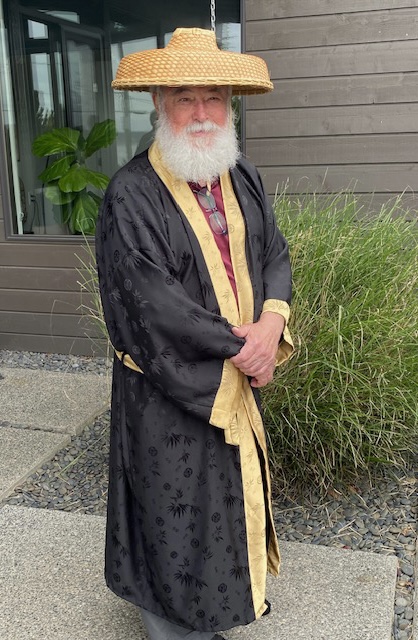
This is Chris Bricker, and I’m thrilled to introduce you to Bill Porter – or Red Pine – one of the world’s finest translators of Chinese Poetry and religious texts. For those of you who already know him, and those of you who will get to know him, he prefers to just being your neighbor Bill Porter. Each week, Bill will bring you a series of enticing installments that we’re calling A Journey Along the Silk Road. So sit back and enjoy the journey, every Tuesday at approximately 5:20 and Friday at approximately 12:15. And lose yourself in the mystery of the Silk Road!
(Airdate: December 30, 2025) We’re in Xinjiang province in the town of Hami, the melon capital of China. After spending a day pedaling around town and seeing the sights, we finally boarded the 8 o’clock evening express to Turfan. And lo and behold, the conductor sold us a couple of berths in the soft sleeper section. The train line doesn’t go to Turfan but runs about 60 kilometers to the north, where travelers can catch the bus into town.
(Airdate: December 30, 2025) We’re in Xinjiang province in the town of Hami, the melon capital of China. After spending a day pedaling around town and seeing the sights, we finally boarded the 8 o’clock evening express to Turfan. And lo and behold, the conductor sold us a couple of berths in the soft sleeper section. The train line doesn’t go to Turfan but runs about 60 kilometers to the north, where travelers can catch the bus into town.
(Airdate: December 16, 2025) We’re still waiting at the Hami train station for the evening train, so we stocked up on Hami’s most famous product. To the Chinese, the name Hami is synonymous with melons. Hami melons have been the most famous melons in China ever since one of Hami’s Uyghur kings sent them to the Chinese emperor, and thanks for leaving him alone. That was less than 300 years ago….
(Airdate: December 16, 2025) We’re in Xinjiang province, in the town of Hami, waiting for the evening train to take us to Turfan, and already we’re regretting our decision to pass up a chance to visit Balikun. Balikun is on the other side of the Tianshan mountains that rise like a gigantic white wall 30 kilometers north of town.
(Airdate: December 9, 2025) We’re only 50 kilometers west of Hami’s present location, trying to hitchhike on a side road that leads to Wupu, the site that Hami once occupied over 2,000 years ago. But we may as well have been in the middle of the Gobi Desert as we stood there waiting for anything with wheels….
(Airdate: December 12, 2025) When China first exerted its influence In the 2nd Century BC, Hami was just beyond their reach. In those days, Hami was known as Yiwu. In subsequent dynasties, Chinese authority in this area waxed and waned. Not only did the northern branch of the Silk Road pass through Hami, another branch veered east at Hami and continued on through Mongolia to Peking. This was the shortcut to northern China…
(Airdate: November 25, 2025) We’re in Xinjiang Province, in the town of Hami, and we’ve already visited the tombs of the Uyghur kings, who ruled Hami over 90 years ago. When the last ruler died in1930, Chinese bureaucrats moved in to fill the vacuum and precipitated a rebellion that spread across the entire Province….
(Airdate: November 18, 2025) We’re in the town of Hami, and we’ve rented a couple of bicycles from an obliging lady at the entrance to our hotel. We didn’t have to pedal far. After one kilometer, we passed a cemetery. We stopped and walked up a pile of steps to a mausoleum at the top of a small hill….
(Airdate: November 11, 2025) We’ve already noted the ancient homeland of the Uyghurs on the shores of Lake Baikal north of Mongolia, and their short-lived empire that encompassed much of central Asia during the 8th Century. We’ve also noticed their practice of a variety of religions. But today it’s hard to find a Uyghur who isn’t Muslim….
(Airdate: November 4, 2025) We’re in Xinjiang Province, the land of the Uyghurs. Today most all of the six million Uyghurs in China are Muslims, and they wear the skulk cap that Muslims wear the world over. But during their moment of glory, where they controlled most of central Asia from their base in Mongolia, they wore their hair beneath the sky, and they bowed to the sun instead of Mecca….