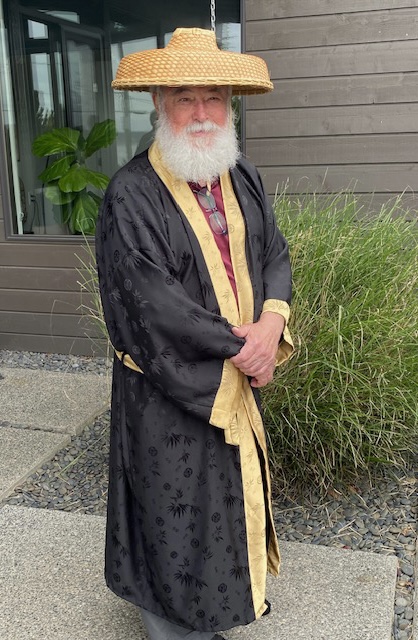
This is Chris Bricker, and I’m thrilled to introduce you to Bill Porter – or Red Pine – one of the world’s finest translators of Chinese Poetry and religious texts. For those of you who already know him, and those of you who will get to know him, he prefers to just being your neighbor Bill Porter. Each week, Bill will bring you a series of enticing installments that we’re calling A Journey Along the Silk Road. So sit back and enjoy the journey, every Tuesday at approximately 5:20 and Friday at approximately 12:15. And lose yourself in the mystery of the Silk Road!
(Airdate: August 19, 2025) The town of Dunhuang was the fourth and westernmost of the major garrisons established along the Gansu Corridor 2100 years ago. In addition to guarding China’s western flank, Dunhuang was strategically located at the junction of the northern and southern branches of the Silk Road. Among the travelers arriving via the northern branch was the Buddhist translator Kumarajiva and his white horse….
(Airdate: 12, 2025) We’re still in Gansu Province and we’re visiting a lake in the Dunes south of Dunhuang. It’s called Crescent Lake, and the magical story behind its name goes like this….
(Airdate: August 5, 2025) We’re in the Oasis of Dunhuang, and we’ve been visiting the Mogao Caves, 25 kilometers to the southeast. The caves are located along a sandstone cliff at the eastern end of the Mingsha Sand Dunes. The dunes themselves are 40 kilometers long and 20 kilometers deep. Mingsha means “singing sand” and there’s a legend behind the name….
(Airdate; July 29, 2025) We’re in Gansu Province at the Mogao Caves, southeast of the center of Dunhuang, an oasis located at a cultural and religious crossroads on the Silk Road….Where, Whoops! The head of this statue is missing, and shouldn’t there be another kneeling statue on the other side of that Buddha? And why is that wall bare? The answer to most or all such questions is Langdon Warner, and Harvard University ’s Fogg Museum.
(Airdate: July 22, 2025) Between the fourth and the fourteenth centuries, Chinese and central-Asian artists covered the walls of the Mogao Caves with thousands off paintings, focusing on a variety of Buddhist subjects, especially the Buddha’s own life, or rather lives. The engine that drives Buddhist doctrine is the law of Karma, the law of cause and effect that extends for as many lifetimes that we live. In addition to the Buddha’s life, another theme that appears in many caves is the Buddhist’s vision of paradise, in particular the western paradise of Amina Buddha….
(Airdate: July 15, 2025) We’re at the Mogao Caves, visiting Caves 16 and 17, where the ancient world’s single most important collection of books was found by a Chinese monk in 1901 and then sold by him a number of years later for the equivalent of two hundred English pounds. Among the collection was the earliest known printed book, as well as that exculpatory form letter for drunks to use the morning after. Our guide completed her account of how China’s greatest literary treasure was stolen by a couple of foreigners, and then we moved on to begin our tour of Mogao’s other treasures—its wall paintings. They Constitute China’s greatest art gallery, as well as its richest source of information about cultural exchange on the Silk Road….
(Airdate: July 8, 2025) We’re at the Mogao Caves, at Cave 17. Taoist Monk Wang Yuanlu found a library of ancient Buddhist manuscripts concealed behind a wall in 1901 Wang needed money to repair the shrines that filled the caves, and exploiters were only too happy to help him out. The Dunhuang Manuscripts, as they’ve become known, constitute the ancient world’s most important Collection of books, including the world’s earliest known form letter for drunks and for the hosts who had to endure them….
(Airdate: July 1, 2025) We’re in Gansu Province at the Mogao Caves, east of Dunhuang. Among the first caves on our list is Cave 17, located behind the north wall of Cave 16’s hallway— the well-known Library Cave. Tragically, after the discovery of this rich trove of literature and manuscripts at the turn off the century, from 1900 to 1915 one foreign expeditioner after the other clandestinely purchased nearly 40,000 documents, scriptures, and other cultural relics found there….
(Airdate: June 24, 2025) We’re 25.kilometers southeast of Dunhuang, just outside the Mogao Caves and their repository of Buddhist art. It all began in the second century BC when the Chinese chased the Huns out if the Gansu Corridor and made Dunhuang the western most outpost of their empire. Dunhuang was where the two main branches off the Silk road met, one from the central Asian kingdoms of the northwest, and the other from the northern Indian kingdoms to the southwest. The city grew rich from the trade that passed through it’s gates….
(Airdate: June 17, 2025) We’re in the town of Dunhuang, and we’ve just checked in to the Flying Asparagus Hotel, the watering hole of budget travelers. Since the hotel is right across the street from the bus station, it’s the place where travelers stop first. The bus station also has the only cheap transportation to the Mogao Caves east of town. The Caves are one of the greatest repositories of Buddhist art….