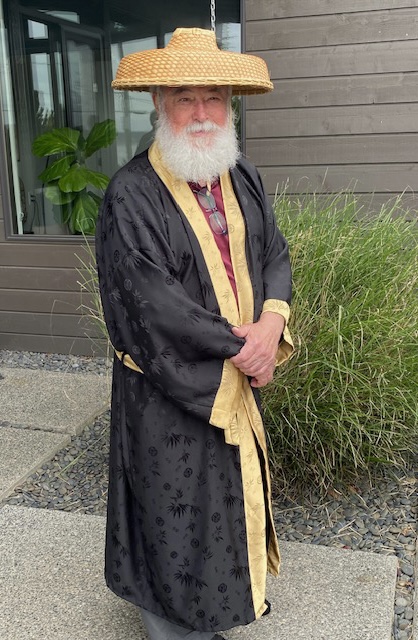
This is Chris Bricker, and I’m thrilled to introduce you to Bill Porter – or Red Pine – one of the world’s finest translators of Chinese Poetry and religious texts. For those of you who already know him, and those of you who will get to know him, he prefers to just being your neighbor Bill Porter. Each week, Bill will bring you a series of enticing installments that we’re calling A Journey Along the Silk Road. So sit back and enjoy the journey, every Tuesday at approximately 5:20 and Friday at approximately 12:15. And lose yourself in the mystery of the Silk Road!
(Airdate: June 10, 2025) We’re rolling down the asphalt on our way from Jiayuguan to Dunhuang. We finally left the snow-capped ridges of the Qilian mountains behind and traded them in for the eroded red and gray of the Gansu Badlands. Despite the nine-hour ride, we were feeling good for the first time in days. Our fevers were gone! Finn honored our change in fortune by penning a bus ride…
(Airdate: June 3, 2025) We’re in Gansu Province, and we’ve just left the town of Jiayuguan and past the fort on the Jiayuguan Path. The fort is where merchants stopped in ancient times to pay tolls, and travelers stopped to have their papers checked. Then they headed into the desert. Many wrote poems on the walls of the fort before heading into the unknown. Visitors still write poems, although the subject matter isn’t quite so ominous and heartrending as it once was….
(Airdate: May 27, 2025) We’ve been staying at the Jiayuguan Guest House, one of the most expensive places we’ve stayed at so far. We figured the Chinese Ministry of Tourism inspector in charge must have been bribed to award them two stars! We’ve been visiting all the surrounding convenient sites, but the one site we decided to forego was the July 1st Glacier, located over 100 kilometers away in the Qilian Mountains….
(Airdate: May 20, 2025) We’re in Gansu Province, visiting the town of Jiayuguan and the Great Wall Museum. The “Great Wall” part isn’t all that great, but our disappointment was somewhat mollified by a wing that included the mummified remains of several women. The exhibit also included dozens of painted bricks that once decorated the walls of the tombs where the corpses were found….
(Airdate: May 13, 2025) After the first emperor united China’s warring states in 221BC, he ordered construction of the wall in order to protect its empire from the periodic invasions from the nomadic tribes to the north. He assigned this monumental task to one of his generals, Meng Tien.
(Airdate: May 6, 2025) We’ve been visiting the Jiayuguan fort and the Great Wall west of town. In honor of its connection to the Wall as a monument to human effort, Jiauguan has built a museum in the shape of the Great Wall itself. Inside, we viewed reconstructions of different sections. Among the stories conspicuously missing was that of the man who built the wall in the first place.
(Airdate: April 29, 2025) Now we’re actually just just six kilometers west of Jiayuguan at the fort for which the city was named. “Guan” means “pass,” and the fort was built to guard the Jiayuguan Pass. Aside from the Great Wall, the fort is the most impressive piece of construction along the Silk Road.
(Airdate: April 22, 2025) We’re in the town of Jiayuguan., and we’re still fighting a bronchial infection we get every time we travel to China. The local hospitals turned out to be a farce, if not a nightmare, so we threw ourselves at the mercy of the local pharmacy. Jiayuguan began its place in Chinese history as early as the Han Dynasty as a.checkpoint along the Gansu Corridor.
(Airdate: April 15, 2025) We’ve been visiting the sights of Jinguan, one of the four garrisons the Chinese had built along the Gansu Corridor 2000 years ago. Despite its long history, the town’s only above -ground relic from the past was its drum tower, which sits in the center of town. We caught a bus that took us to the next town down the line, which was Jiayuguan, 22 kilometers to the west.
(Airdate: April 8, 2025) We’re in the towns of Jinguan or “Wine Spring,” We’ve just concluded our visit to the spring. On our way back into town, we stopped at a museum that had the usual collection of stones and bones and busted pots, but it did feature one unusual exhibit.