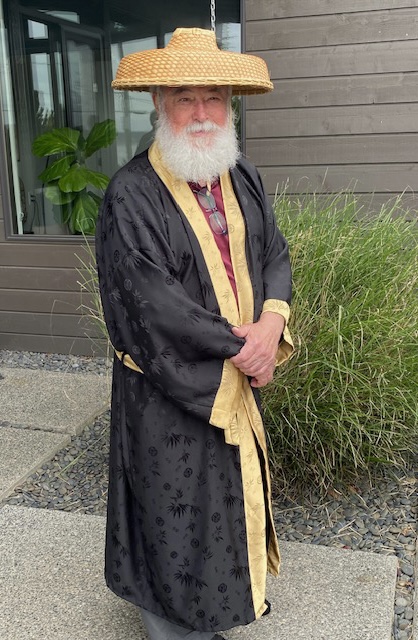
This is Chris Bricker, and I’m thrilled to introduce you to Bill Porter – or Red Pine – one of the world’s finest translators of Chinese Poetry and religious texts. For those of you who already know him, and those of you who will get to know him, he prefers to just being your neighbor Bill Porter. Each week, Bill will bring you a series of enticing installments that we’re calling A Journey Along the Silk Road. So sit back and enjoy the journey, every Tuesday at approximately 5:20 and Friday at approximately 12:15. And lose yourself in the mystery of the Silk Road!
(Airdate: July 28, 2026) Despite the daily arrival of a few hundred day trippers, the one thing that hasn’t changed is that the slopes surrounding Heavenly Lake are still home to the Kazakhs, who’ve been grazing their sheep here for hundreds, if not thousands, of years. To supplement their income they rent out yurts to the handful of visitors who stay past sundown…
(Airdate: July 21, 2026) When the Chinese first noticed the Kazakhs, they were part of the confederation of tribes known as the Wusun. That was two thousand years ago. Over the succeeding centuries the Wusun confederation mingled with other nomad groups, including the Turks, the Uyghurs and the Mongols. And finally in the 15th century they formed their own independent tribe…
(Airdate: July 14, 2026) We’re in Xinjiang Province at Heaven Lake, high in the Heavenly Mountains north of Urumqi, lying in our Yurt under a pile of blankets, sipping Cognac and recalling the story of how the Chinese and our hosts got together—our hosts being the Kazakh nomads in the Yurt next-door…
(Airdate: April 28, 2026) The rubble that remains of Jiahe dates back a thousand years to the Tang and Sang Dynasties, before the city was put to the sword by the Mongols in the 13th century. Though limited in size, it was one of the most prosperous cities along this part of the Silk Road, and its ruins are in far better shape than it’s larger neighbor to the east As we walked around the island, we were surprised by the number of temples and stupas that covered the island’s summit….
(Airdate: April 21, 2026) Today we’re heading west to another set of ruins, in this case the Jiahe runs in the Yarnaz Valley, only 13 km away, and within bicycle range. It’s a natural fortress located atop a steep cliff on a leaf-shaped plateau between two deep river valleys, and it was an important stop along the Silk Road….
(Airdate: April 14, 2026) We’re in Xinjiang Province, visiting the Astana Tombs, where the elite were buried fifteen hundred years ago. Since we remembered our flashlights we were able to visit the underground chambers. Most of the artifacts discovered there have been removed to a museum, but there are a number of well-preserved corpses and a number of wall paintings. One of the paintings in particular is worth mentioning….
(Airdate: April 7, 2026) We’ve been visiting the ruins of the ancient city of Gaochang, 42 kilometers southeast of Turfan. On the way back to town we also visited the Astana Tombs, just north of the city. This ancient cemetery served as the burial site for both the elite and commoners from the Gaochang region between the 5th and 10th centuries. The extreme aridity of the area has kept the bodies buried there is a remarkable state of preservation….
(Airdate: March 31, 2026) We’re walking among the ruins of the ancient city of Gaochang. One pile of the ruins there that are distinctly different from other piles is the Buddhist temple at the southwest corner of the city. Much of the interior is still intact, including the walls and the huge central pillar around which the pilgrims once walked….
(Airdate: March 24, 2026) Nowhere else in China are the ruins of Gaochang so accessible, so extensive, or so impressive. Former garrisson Gaochang had soon become the capitol of an independent state, and it flourished as a cultural and political center until it was destroyed by the Mongols in the 13th century. During his excavations here in 1905, German archeologist Le Coq found more than an underground chamber full of corpses and Buddhist art….
(Airdate: March 17, 2026) We’re 45 kilometers to the east of Turfan, at the ruins of the ancient city of Gaochang, the capitol of the Kingdom of Turfan, and the place where those monks came from who carved out those caves. Gaochang began lIfe in the first century B.C as a small Chinese garrison to prevent the Huns from gaining control of that portion off the Silk Road. But it was too far away for the Chinese to stay in charge for very long…